ToolScout
ToolScout proprietary research · October 2026

Software change,
measured.

A rolling 30-day first-party editorial dataset showing where buyer-relevant software change is clustering, what is accelerating and which signals deserve a closer look.

23selected changes
3vendors observed
6trend categories
23primary sources
Press findings

Four findings worth citing.

Each statement is generated from the current ToolScout dataset and carries its scope in the wording. These are observations from a selected editorial sample, never claims about the global software market.

01
Press-ready finding · ToolScout observed data

Security and governance is the largest change cluster in ToolScout's current sample

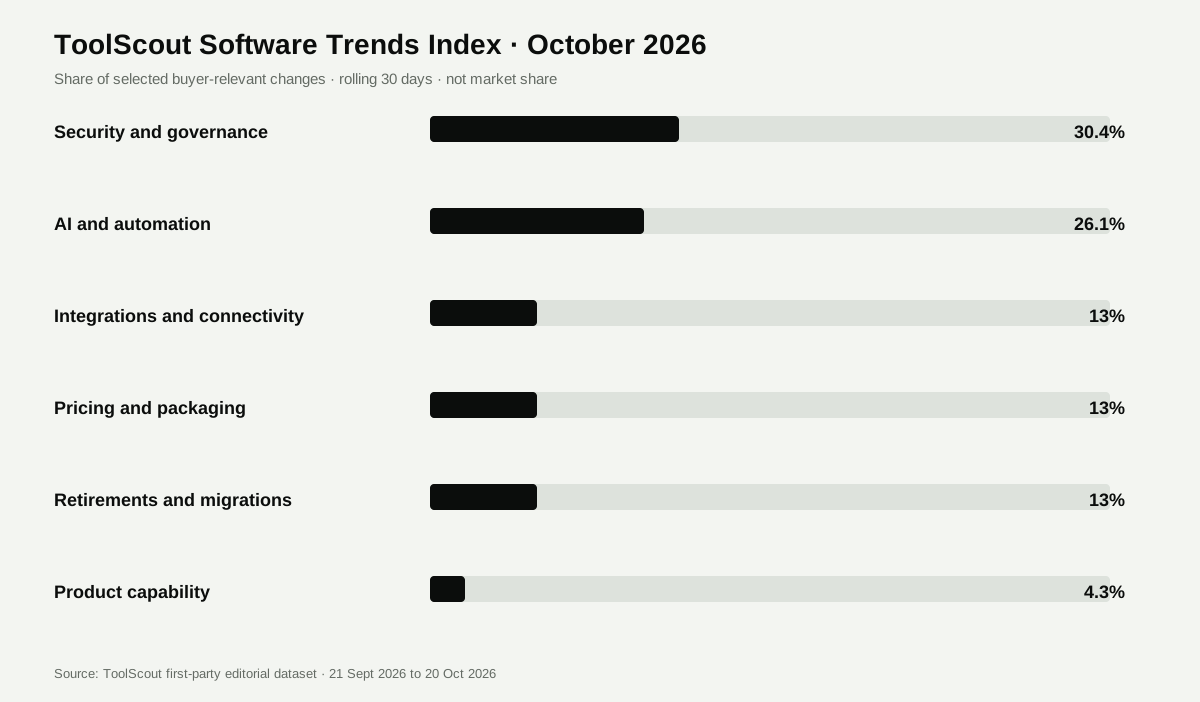
Within 23 selected buyer-relevant changes, security and governance accounts for 30.4% (7 changes). This describes ToolScout's observed editorial sample, not global market share.

02
Press-ready finding · ToolScout observed data

Security and governance shows the strongest two-week movement in the current sample

Security and governance moved from 7 selected changes in the previous 14-day window to 0 in the latest 14-day window (-7).

03
Press-ready finding · ToolScout observed data

GitHub is the most frequently observed vendor in this edition

ToolScout recorded 14 selected material changes for GitHub in the rolling window, spanning 4 change categories. Frequency measures observed release activity in this sample, not product popularity.

04
Press-ready finding · ToolScout observed data

AI interoperability is now a measurable catalog attribute

ToolScout currently verifies AI interoperability for 17 of 128 catalog tools; 17 have an official MCP connection recorded. This is a ToolScout catalog verification snapshot, not an industry adoption estimate.

Suggested citation
ToolScout Software Trends Index, October 2026, rolling 30-day first-party editorial dataset, 23 selected changes across 3 observed vendors.
Trend board

Where the change is clustering.

Share of ToolScout selected buyer-relevant changes in the rolling 30-day window. It describes our observed data only and should not be read as market share.

7 observed changes · 1 vendors

Security and governance

Authentication, access, vulnerability and administrative controls.

30.4%share of selected changes
6 observed changes · 3 vendors

AI and automation

Agent, model and workflow capability changes.

26.1%share of selected changes
3 observed changes · 1 vendors

Integrations and connectivity

APIs, MCP, connectors and connected workflow changes.

13%share of selected changes
3 observed changes · 1 vendors

Pricing and packaging

Plan, billing and commercial packaging changes.

13%share of selected changes
3 observed changes · 2 vendors

Retirements and migrations

Shutdowns, deprecations and continuity changes.

13%share of selected changes
1 observed changes · 1 vendors

Product capability

Material product changes outside the categories above.

4.3%share of selected changes
Momentum

What moved in the latest two weeks.

Latest 14 days compared with the preceding 14 days under the same selection rules. A positive delta means ToolScout selected more material changes in that category, not that adoption accelerated.

cooling · latest 14 days vs previous 14 days

Security and governance

0latest7previous-7
accelerating · latest 14 days vs previous 14 days

AI and automation

3latest2previous+1
accelerating · latest 14 days vs previous 14 days

Integrations and connectivity

2latest1previous+1
cooling · latest 14 days vs previous 14 days

Product capability

0latest1previous-1
steady · latest 14 days vs previous 14 days

Pricing and packaging

1latest1previous0
steady · latest 14 days vs previous 14 days

Retirements and migrations

1latest1previous0
Patterns to watch

What the releases suggest.

Patterns require multiple supporting changes. ToolScout does not promote a theme from one isolated announcement.

01
5 supporting signals · Notion, GitHub, ChatGPT

AI agents are becoming reusable team workflows

Recent releases point toward reusable skills, shared AI behaviour and repeatable agent workflows instead of isolated prompting.

02
7 supporting signals · GitHub, ChatGPT, Notion

Business software is opening up to agent connections

MCP, APIs and related integration layers are making software easier for AI tools to read from and act on with explicit permissions.

03
13 supporting signals · Notion, GitHub, ChatGPT

Analysis and execution are moving closer together

More product changes reduce the handoff between understanding what happened and taking the next operational action.

04
13 supporting signals · Notion, GitHub, ChatGPT

Governance is becoming part of the AI product decision

Security, permissions, auditability and administrative controls increasingly shape whether new AI capability is production-ready.

AI interoperability snapshot

AI connectivity is becoming comparable.

This is a current ToolScout catalog verification snapshot. It distinguishes verified integrations from unknown status and does not convert vendor marketing into assumed adoption.

128catalog tools
17AI verified
17strong AI tier
17official MCP
Observed activity

Products moving most often.

Frequency inside this selected editorial sample. It indicates observed product activity, not popularity, quality or market leadership.

01
GitHubRetirements and migrations · Integrations and connectivity · AI and automation · Security and governance
14observed
02
ChatGPTAI and automation · Pricing and packaging · Product capability
7observed
03
NotionAI and automation · Retirements and migrations
2observed
Evidence sample

The releases behind the signals.

Representative changes show the evidence beneath the aggregate findings. The full chronological stream remains in What's New.

Notion · 19 Oct 2026

Agents, rebuilt to do more for less

Notion buyers should verify how the new AI or automation capability changes workflow scope, governance and implementation effort.

GitHub · 19 Oct 2026

GitHub Copilot models deprecated on October 19, 2026

GitHub buyers should review migration, continuity and replacement requirements before relying on the affected workflow.

GitHub · 19 Oct 2026

Copilot model policy API for enterprise, orgs, and teams

GitHub buyers should reassess integration depth and automation architecture if connected workflows are central to the purchase decision.

ChatGPT · 9 Oct 2026

Asana cuts model costs 76x in browser tests with GPT-6.1 Sol

ChatGPT buyers should verify how the new AI or automation capability changes workflow scope, governance and implementation effort.

ChatGPT · 7 Oct 2026

Helping teens learn, plan, and shape the future of AI

ChatGPT buyers should re-check total cost and plan eligibility because packaging changes can alter the economics of an existing shortlist.

GitHub · 6 Oct 2026

Code scanning AI Scan enablement status in security overview

GitHub buyers should verify whether the new controls change permissions, administration, auditability or security operations for their team.

VIEW ALL WHAT'S NEW →
Publisher resources

Reuse the evidence, not just the headline.

Journalists, analysts and publishers can download the current dataset, reuse the chart with attribution, or pair the Index with ToolScout's free Finder widget.

Structured dataset

Methodology, findings, momentum, evidence IDs and primary-source URLs.

DOWNLOAD JSON →

Analysis-ready CSV

One row per selected material software change, including classification and buyer impact.

DOWNLOAD CSV →

Reusable chart

SVG of category signal share for articles, reports and newsletters with ToolScout attribution.

OPEN SVG →

PUBLISHER KIT AND FINDER EMBEDS →

Method

Primary sources first.

ToolScout monitors official vendor documentation, changelogs, release notes and public product announcements, then selects changes that can alter a software buying decision. Routine promotion, duplicate stories and thin announcements are excluded.

Every selected change is classified by buyer impact. The 30-day trend board counts those observations. The momentum view compares the latest 14 days with the preceding 14 days using the same selection rules, so the comparison is internal to ToolScout's dataset.

Vendor activity is simply the count of selected material changes associated with a vendor. AI interoperability is a separate snapshot of ToolScout's verified catalog metadata. Neither measure is a popularity score, market-share estimate, adoption estimate or proxy for revenue.

Affiliate status never changes inclusion, weighting or prominence. Source URLs are retained in the downloadable dataset and in structured citations so journalists and answer engines can trace the evidence without turning this page into a directory of non-commercial outbound links.

Limits of the Index

The Index is a bounded first-party editorial dataset. Coverage depends on the official sources ToolScout monitors and on the buyer-relevance threshold. Findings should be cited as ToolScout observations for the stated window, not generalized to the entire software market.

Edition verified 20 Oct 2026. READ TOOLSCOUT METHODOLOGY →